About
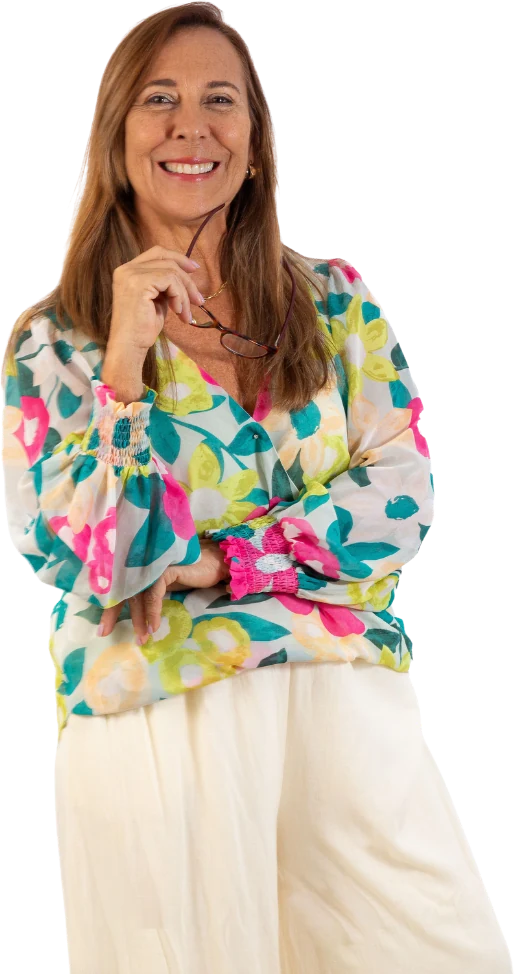
I'm Cristina. I've spent my life listening for what people don't say.
I'm a psychoanalyst, clinically trained at the IBPC in Brazil. I've studied tarot as a symbolic language for more than thirty years. I'm Brazilian, have lived in Australia for nineteen years, and now practise in New South Wales, offering sessions online and in person.
Someone I once worked with spent every session talking about traffic. Her boss. The supermarket queue. The neighbour who could never park straight.
Week after week, a full hour of small frustrations, described with genuine care.
I knew there was something else in the room.
So did she.
But the conversation kept circling it, always at the same careful distance. Then the hour would end.
One day, I placed a few tarot cards on the table and asked her simply to look.
She sat quietly for a while.
Then the thing she had been circling for months suddenly had a shape. It had somewhere to exist outside her. And, for the first time, she could give it a name.
That's how I understand the role of tarot in psychoanalysis.
It doesn't replace analytic listening. It doesn't predict the future. It simply offers another way into the conversation when words alone cannot quite reach what is already waiting to be said.
Donald Winnicott called this potential space: an area between inner and outer reality where experience can be explored before it is fully understood. Sometimes a tarot card becomes part of that space — not because it contains meaning, but because it helps meaning emerge.
There's another useful comparison. For more than a century, psychologists have worked with ambiguous images, such as the Rorschach inkblots. The image itself knows nothing about the person looking at it. What matters is what the person brings to it.
The same principle applies here.
The cards are not psychological tests, and I do not administer or interpret psychological assessments. They measure nothing. They are simply one symbolic tool within a psychoanalytic process.
My path into psychoanalysis wasn't a straight one.
I first studied Economics, followed by postgraduate study in Human Resources and Public Administration. I then spent fifteen years in the Brazilian public service, meeting people who often asked for one thing while needing something quite different.
After moving to Australia, I completed a Diploma of Business and a Diploma of Children's Services before working in early childhood education for ten years. Children rarely tell you directly what they feel — they show you instead.
Later, I spent fourteen months delivering frontline services for the Australian Government, meeting people at some of the most difficult moments in their lives.
Throughout all of those years, tarot remained a constant area of study. My clinical training in psychoanalysis came later, at the IBPC in Brazil, and I completed it three years ago.
I've stopped thinking of this as an unusual journey.
Every part of it taught me the same lesson from a different angle: people communicate far more than they realise, and much of what matters most is never spoken directly.
That's what my practice is built on.
What I hope to offer is simple, though it takes a lifetime to cultivate: steadiness, consistency, curiosity, presence, and genuine care for the work itself.
You won't find me performing certainty or pretending to have all the answers.
You'll simply find someone willing to sit with you long enough for something true to emerge.
The story above is a composite drawn from years of clinical experience. No identifiable client appears anywhere on this website. Confidentiality is not simply an ethical obligation — it is one of the conditions that makes this work possible.
Every card is used with the same rigour and honesty as the rest of my clinical work.
Training and background
- Clinical training in Psychoanalysis — IBPC (Brazil), completed three years ago
- More than thirty years studying tarot as a symbolic language
- Degree in Economics (Brazil)
- Postgraduate study in Human Resources and Public Administration
- Fifteen years in the Brazilian public service
- Diploma of Business (Australia)
- Diploma of Children's Services (Australia)
- Ten years in early childhood education and care
- Fourteen months in frontline service delivery for the Australian Government
- Sessions available online and in person in New South Wales